
LACK OF ADULTHOOD OR ABSENCE OF YOUTH? RETHINKING THE ACCOMPANIMENT OF YOUNG PEOPLE
Sara Ortega, Project Manager Accompaniment and Caterina Ponte, mentoring technician of the Zing program.
There are various professional profiles in the employability improvement programs that develop the function of accompanying the life itineraries of young people. If there is one thing that all the profiles have in common, it is that they share a privileged place from which to stimulate young people in learning how to make their own decisions and face their own life challenges.
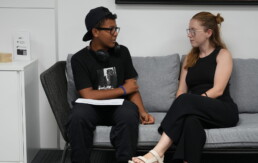
These itineraries are not simply linear trajectories towards labor market insertion, but profoundly human, performative and transformative experiences that affect, in multiple dimensions, the way of being and existing of those who follow them. In this process, they not only acquire skills or technical competencies, but also reconfigure their identity, question their social roles, and rediscover their place in the world. Recognizing these itineraries as living and dynamic processes also requires an approach that values the uniqueness of each story and the diversity of experiences, allowing young people to be protagonists in the construction of their own journey towards a meaningful future.
We hope that, through this reading, we can pause for a while in the practice of accompanying young people, allowing us to rethink our praxis. The objective: to promote the use of simple tools, questioning and listening, aimed at fostering the humanization of accompaniment and the protagonism of the young apprentices in their processes of development and creation of an integral life project.
To speak of youth is to enter a terrain full of potentialities, contradictions and possibilities. However, the way in which society, and in particular programs aimed at young people, perceive them is often marked by an adult-centric view that reduces their experiences to a transition to a “full” adulthood. This adulthood is defined under standards inherited from previous generations, which respond to a life model that is no longer always functional or applicable in the current context. These standards, based on linear and predictable trajectories (such as access to formal education, obtaining a stable job and achieving well-defined biographical milestones), clash with a contemporary reality characterized by the speed of change, job insecurity and generalized uncertainty.
In this context, young women not only face pressure to meet the expectations of others, possibly internalized, but are also faced with the task of reimagining and constructing new ways of narrating their identity and life projects. These new narratives require flexibility, openness and a critical eye to challenge the impositions of obsolete models, while recognizing the multiple ways in which youth live, create and resist in a constantly evolving world.
Youth, when we move away from this view of “lack of adulthood” and recognize it as a stage of its own and complete in itself, is curiosity, creativity, desire to learn and transforming force. Focusing on what young people are allows us to recognize them as agents of their own itineraries. Under this perspective, the young person ceases to be merely a learner, to become someone who teaches us to “think and look from another point of view”. According to Garcés (2020), “the learner is a point of view that makes us discover that the learning we do shapes the worlds we share. Their experience is not separated from the world, but fully traversed by its social, political, economic and labor determinations, and in tension between them.”
This recognition implies understanding that itineraries are not only individual trajectories, but processes that are deeply intertwined with the social fabric of which they are part. Thus, when young women trace their own paths, they not only transform their personal lives, but also impact and re-signify their communities, contributing new ways of thinking, doing and building.
Being agents of their own itineraries means providing young women with tools, but also with the space and legitimacy to decide, make mistakes, learn and create. From this perspective, accompaniment is not limited to guiding them towards a pre-established objective, but becomes a relationship where the girls lead the process and the professionals stand by their side as allies. The practice thus becomes an exchange of learning, a reciprocal activity, and not an action on a subject/object that plays a passive role.
This double transformation, of their own lives and of their contexts, positions youth not as a future under construction, but as a present full of action. It is at this intersection between the personal and the collective that their true potential lies, and where accompaniment acquires a profoundly transformative value.
In this sense, accompanying young people implies a dialogic practice that provokes reflection and decision making. The dialogue process is premised on the recognition of the young person as a free, critical being with the potential for responsibility. In this framework, responsibility can manifest itself in different ways: sometimes as a conscious responsibility, where the individual assumes and exercises this quality intentionally, and other times as a potential responsibility, where the person, being unaware of his or her responsible capacity, is in the process of discovering and developing this competence. In this way, the establishment of a dialogue would become the humanizing ingredient of accompaniment.
However, in order for the design of co-constructed life itineraries to be possible through dialogue, it is essential to take care of the elements that configure it: the question and the present listening .
The question
Questioning is much more than a technique of accompaniment: it is an act of recognition (Honneth, 1992). Asking implies assuming that the other person has an answer, even if he/she has not yet formulated it. Instead of acting as experts who impose their vision, we professionals must position ourselves as co-explorers of the path, guiding the young women to discover their own answers and meanings. This accompaniment not only recognizes their capacity to decide, but also activates analytical thinking by integrating a deep reflection on the context in which they find themselves. The act of questioning becomes a tool to enhance the experience of self-efficacy about their life, while fostering their ability to make informed and conscious decisions in the present and the future.
Well-designed questions have the ability to foster critical thinking. When a young woman is invited to question her decisions, imagine alternatives and evaluate risks, she is not only moving toward employability, but also developing fundamental life skills. This does not mean that accompaniment is no longer necessary, but rather that it becomes a guide.
How to train the question? Asking questions is not a spontaneous act; it requires practice, intention and sensitivity. We share some tips on how to train it:
Know before you ask.
A good question starts from a genuine understanding of the young person’s context. You can’t ask “What motivates you?” if you haven’t spent time getting to know what their interests and concerns are.
2. Open-endedquestions.
The open-ended question acts as a catalyst for self-knowledge and the development of metacognitive skills in young women. Through questions such as “What do you wish for yourself?” or “How do you imagine your future?”, we not only help them identify their goals, but also provide them with a space of connection with their desires that encourages them to recognize themselves as active agents in their own lives.
3. Avoid leading or leading questions.
Questions such as “Why didn’t you take advantage of this opportunity?”, generate a defensive reaction, while “At the time, what prevented you from taking advantage of this opportunity and how could we work together now?”, encourages collaboration and trust.
4. Adapt the language.
Questions should resonate with the way the young woman expresses herself and understands the world. Using an approachable and respectful tone is as important as the content of the question itself.
Present listening
In the discovery of answers through questions, our present listening becomes the fundamental catalyst of human dialogue. Asking questions without being willing to listen vitiates the question, as it deprives it of curiosity and genuine interest. When the companion listens, the bond between companion and young person is strengthened, generating a safe space of trust necessary for openness and sincerity. Listening, being present, consists of wanting to attend to the experience of the other in a conscious and empathetic way. It implies that there is no judgment, no transfer of responsibilities, and no attempts to shape the discourse.
We ask ourselves: how can we train present listening? To learn how to exercise it, we dare to share five good practices:
1. Empathetic listening
Listening from the other person’s place allows us to better understand their emotions and points of view. We could say, “You seem to be frustrated by this situation, do you want to tell me more?”, thus showing more empathy and curiosity.
2. Listening without judgment
Suspending judgment in conversation creates a safe space. An example would be to avoid critical and closed responses, opting for comments such as, “I understand that was difficult for you, how do you think we could handle it together?”.
Another exercise would be to decrease the halo effect. The Halo effect is a cognitive bias that leads us to evaluate a person in a generalized way based on a single positive or negative characteristic. To mitigate the Halo Effect in our interactions we can: 1) Recognize the bias: be aware that this bias exists and can influence our judgments. 2) Gather objective information: base our evaluations on concrete, observable data, rather than subjective impressions. 3) Separate qualities: evaluate each characteristic of a person independently, preventing one general impression from affecting other assessments.
3. Listening with silence
Silence allows the girls to reflect and can therefore become an even more powerful tool than words. As chaperones, when it is time to ask a question, we can wait patiently without interrupting, allowing the young woman to find her own answers.
4. Listening with positive reinforcement
Statements such as “tell me more to get closer to how it is affecting you” or a simple nodding gesture help show interest and demonstrate that we are engaging in the dialogue. An example might be, “What you are saying is important, thank you for sharing.”
5. Listening with an exploratory attitude
To deepen the topic and avoid misunderstandings, it can be a good technique to ask questions to increase understanding. The practitioner could ask: “Could you explain a little more what you meant by…?” or paraphrase what the young person has said, rephrasing the words in a new way without changing the essence and meaning of the message.
Could accompanying through questioning and present listening be genuine strategies to put “youth” in our way of approaching the other?
Questioning and present listening recognize the value of silences, stumbles and stories that are often left out of the dominant narratives. We dare to investigate failures and to look carefully at those spaces where there seems to be no light, understanding that in these ignored corners may lie fundamental keys to re-signify and transform experiences, experiences and skills. Often, these remain hidden because young people have not given them importance, as they belong to “the sphere of the unvalued”: unknown aspects perceived as natural, automatic or everyday within their universe of competencies. However, making these apparently ordinary dimensions visible opens up the possibility of recognizing their true potential and of valuing them as significant resources in their personal-professional and community development.
Perhaps, while we insist that young people lack some “adulthood”, could we not ask ourselves if we are lacking a bit of “youth”, how do we maintain or recover that spark of youth? As professionals who accompany young people, do we really know how to put into practice the competence of “learning to learn”? Are we willing to learn together with them, from what happens and not from what we think should happen? Do we take advantage of those spontaneous and curious questions they throw at us to open spaces for mutual learning?
Understanding accompaniment as an act of living curiosity implies assuming the radical idea that each young person has the right to learn where to go, to do and to undo in the itinerary of his or her own life purpose/project.
Garcés, M. (2015). School of apprentices. Galaxia Gutenberg.
Honneth, A. (1992). The struggle for recognition: For a moral grammar of social conflicts. Ediciones Grijalbo.