
EMPLOYABILITY CONFERENCE: CROSSING PERSPECTIVES FOR AN INNOVATIVE RESPONSE TO A GLOBAL CHALLENGE
Ana Caruezo Carnero, science and social communicator.
The conference “Youth Employability: Crossing perspectives for an innovative response to a global challenge”, organized by Nous Cims in collaboration with Second Chance Schools, Somos F5, Ayuda en Acción and Simplon.co, had as its purpose to become a space for meeting, exchange and reflection among professionals working in the field of youth employability. to become a space for meeting, exchange and reflection among professionals working in different fields of work. in different countriescountries in order to to improve training and employment opportunities for young people. and young people.
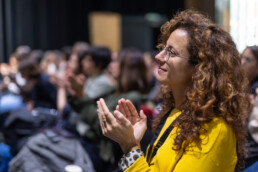
The meeting focused on the need to accompany from an integral perspective: beyond technical training, it is essential to attend to the emotional well-being, concerns and life contexts of each young person.
Throughout the meeting, a deep conviction was shared: young people are trailblazers. Whether in St. Louis, Barcelona, Paris or Bogota, they share the same transforming force that invites them to cooperate, to cross perspectives and to weave an intercontinental network capable of proposing innovative responses to common challenges.
Putting young people at the center of change
The first block, “How to transform training to place young people at the center of change”, brought together different speakers who agreed on a key idea: young people are not beneficiaries; they are the protagonists of their own training and life process.
Rather than technical competencies, they stressed the need to work on the self: strengthening self-esteem, channeling emotions, building bonds, learning to work in a team and developing all those soft skills (soft skills) that support autonomy and a professional future. As Moussa Diop, CEO of GPES x Challenge Hub, expressed, “When you accompany young people you are looking at the short term, but always with an eye to the future.”
They defended a vision of education as a transformative process and not as the attainment of a degree, and of employment not only as a position to access, but as a way to build a life project: a path towards autonomy, dignity and social participation.
From this point of view, accompaniment must be respectful and not imposing. Only in this way can authentic motivations appear that allow each young person to trace itineraries that help them to grow, discover themselves and project themselves beyond the short term.
Shared challenges: building real bridges to the world of work
The second block addressed an urgent challenge: how to build solid bridges between education and the world of work. The speakers agreed on a clear diagnosis: the education system and the business system speak different languages.
Good practices were shared, focusing on an essential principle: in order to provide proper guidance, it is necessary to know the person (his or her life path, concerns and hopes) and to convert all this potential into a real asset for employability. It was also stressed that training and exploring new paths in life is always possible, if there is an ecosystem that accompanies, opens doors and makes young people feel capable.
Faced with this mismatch, the challenge is to build a solid and meaningful bridge between two realities that too often do not communicate in the same way. Bouna Kane, Director, SIMPLON.co Africa, commented:“We have trained more than 30,000 people, with an insertion rate of more than 90%. What are we doing to achieve this in Africa, being a poor continent? We have turned the tables, focused on the method and tried to replicate the business world in the classroom.”
And as Juanjo Berbel pointed out, work is flexible, changing. And that is why we must combine the 3 Cs:
- Knowledge: enhancing soft skills, 7 out of 10 companies value them above technical knowledge.
- Co-responsibility: demand transparency and inclusion from companies, and openness to the world of work from the education system.
- Cooperation: building alliances based on experiential learning, practical itineraries and shared challenges.
Looking ahead: innovation, impact and opportunities
The third block, dedicated to innovation and impact assessment, highlighted how both elements become key drivers for improving youth employment opportunities.
Innovation (technological, social or methodological) generates education and training needs, creating new professional profiles and opening paths that did not exist before. This makes it a window of opportunity for young people. At the same time, innovations provide competitive advantages that make them attractive to the market, generating spaces where young people can stand out and build trajectories with greater projection.
The speakers also underscored the value of impact evaluation as a collective learning tool that makes it possible to continuously improve programs, adjust interventions and ensure that they respond to the real needs of young people and the territories.
A global network to move towards fairer employability
The day concluded with a shared reflection: the challenges facing young people in the North and South of the planet share common roots, even though they are expressed in different cultural contexts. Unlearning imaginaries, listening, sharing and co-creating were revealed as essential ingredients of social innovation.
As a result of the connections created during the day, the creation of an international coalition for youth and social innovation was announced, aimed at continuing the exchange of experiences, identifying replicable innovations and promoting new partnerships to drive systemic change.
As Astrith Johana Armijo, coordinator of the Red Juvenil Chocoanas de Colombia, said: “Networking is much more powerful and the fruits that we can harvest are much greater”.