
DIGITAL TRANSFORMATION FOR THE IMPROVEMENT OF ADOLESCENT EMOTIONAL WELL-BEING. KOA PROGRAMME EXPERIENCE.
Roger Caro, Koa Programme technician.
When talking about digital transformation in our organizations, we may have made the mistake of believing that it consisted of incorporating technologies into our way of working without reflecting on what challenge or problem the technology helps us to solve. Digital transformation is not about updating your technology, it is about updating your strategy and your way of thinking (Rogers, 2016).
From the KOA program, it has been a challenge to address the digital transformation with the objective of evaluating the impact that the program has on the promotion of the emotional well-being of adolescents. With that in mind, we bet on the implementation of Pentabilities in the program.
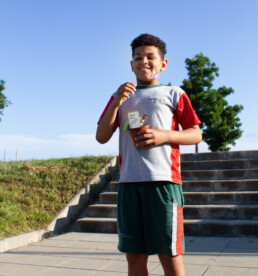
Pentabilities is a project that places social-emotional skills and their formative assessment at the center of social-educational practice, in order to have a direct impact on improving the social well-being of adolescents in the future. Pentabilities is based on the premise that those adolescents who have more tools and strategies for emotional management, the establishment of personal goals and purposes, conflict resolution or positive interpersonal relationships, are more likely to succeed both at the educational level and in other areas in which they will find themselves throughout their lives (personal, work, family…) (Equip Pentabilities, 2022).
What does Pentabilities bring to the KOA Program?
- A common language. It provides a definition of five major socioemotional skills, which are Responsibility, Cooperation, Autonomy and Initiative, Emotional Management and Thinking Skills. Based on these major skills, it defines 35 behaviors to be evaluated, which will allow us to know the degree of development of each of these skills. These skills and behaviors will be part of the common language between educators and adolescents, allowing us to understand the same when talking about empathy, responsibility or teamwork, among others. Furthermore, these behaviors have a correspondence with the competencies defined in the framework of the Program (KOA Programme, 2023:29).
- Orienting the gaze. Knowing which behaviors are linked to the development of the competencies allows us to plan the activities for each session, taking into account that the competency we want to work on will determine the behaviors to be addressed in the session. It helps us to focus on each activity.
- Behavioral assessment. By evaluating the behaviors that occur, we avoid biases. It allows us to have a constructive and non-stigmatizing look, as well as to move away from prejudices and general perceptions, by focusing on how adolescents behave in certain situations, and not on whether they behave in a certain way or another. These behaviors are recorded in each session, as they occur.
- Rethinking feedback. The feedback we will give will be based on the behaviors that have occurred during the activities, giving the adolescents the opportunity to analyze those behaviors that make them feel good, and those that do not, to establish concrete action plans to change them.
To foster the successful implementation of Pentabilities in the KOA program, we have focused efforts in the following areas:
- Developing talent. We have invested a lot of energy in training the professionals in the use of Pentabilities, both face-to-face and virtually, as well as on-site mentoring sessions in the program sessions.
- Start small. To get started with Pentabilities we have limited the behaviors to seven, in order to have a manageable list to evaluate, and these will be evaluated during the initial and final moments of the session. In this way we will achieve small successes that will encourage us to continue implementing the tool, and on which we will base the incorporation of more behaviors to be observed.
- Decriminalize error. We have invited educators to use Pentabilities on a daily basis, accepting that there may be errors in use, but that they are part of the learning process.
- Planned implementation, starting with a few groups, but increasing year by year the number of groups and educators applying Pentabilities.
And yes, it also provides us with a mobile application where we can record the behaviors that occur in each session, and a web platform where we can have information on the development of each of the skills in the different sessions, as well as generate reports based on the observations.
However, as we have seen, the use of technology is the last step, after achieving a common language, orienting the gaze, evaluating behaviors and redefining feedback. Because, ultimately, according to Marcet (2019), “digital transformation is not simply about injecting technology, but changing mindsets and ways of operating of people.”
References
Equip Pentabilities. (2022). Pentabilities, including life skills. Barcelona: Jaume Bofill Foundation.
KOA Programme (September 2023). KOA PROGRAMME – Nous Cims Private Foundation. Retrieved from https://www.nouscims.com/wp-content/uploads/2023/10/30_OCTUBRE_digital.pdf
Marcet, X. (9 de Maig de 2019). Indicador d’Economia. Retrieved from Indicador d’Economia: https://www.indicadordeeconomia.com/opinio/159/transformacion-digital-el-reto-son-las-personas
Pentabilities S.L. (2024). Pentabilities S.L. Retrieved from Pentabilities S.L.: https://pentabilities.com/index
Rogers, D. (2016). The Digital Transformation Playbook: Rethink your Business for the Digital Age. New York: Columbia University Press.