
BENEFITS OF THE FAMILY-SCHOOL BOND
Anna Fillat and Cristina Morató, KOA Program Technician and Project Manager Komtü Program
How can we strengthen the links between families and teachers?
How do educational teams perceive the effort and involvement of families in their children’s learning?
Can a closer relationship between family and school reduce absenteeism and improve educational success?
These are some of the questions we ask ourselves from the Komtü program and the KOA program of the Nous Cims Foundation, because we know that the collaboration between school and family is key to the emotional and academic well-being of children and adolescents.
This article aims to contextualize the importance and benefits of the bond between the child and his/her family, as well as to offer key tools so that the school can generate changes in its dynamics and reinforce a closer and closer relationship with the families.
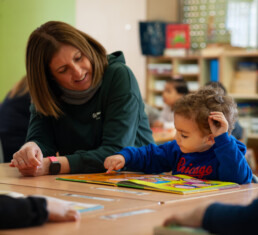
Family-child bond
Human beings are social beings since we are born. The first relationship is the affective bond that the child establishes with the family, with the mother, father or the person who dedicates more hours to him/her (Ramos and González, 2017); through which he/she will learn the first words and the first behavioral guidelines.
The family plays a fundamental role in the formation of the child’s values, attitudes and habits. It is in this environment where they receive their first experiences and establish their first relationships, which will become the basis of their future interactions. In addition, the family is the main transmitter of culture and values. Later, in a second phase of socialization, the child will be integrated into different social groups and will establish constant relationships with other people, since he/she needs the company and interaction with others for his/her development. In this process, other social agents will intervene, such as the school or peers, who will assume, to a greater or lesser degree, part of the educational responsibility that initially corresponded to the family.
Benefits of the family-school link
The links between families and schools are not always easy, but they share a common goal: the well-being of children. The responsibility of both agents is fundamental. According to Ortiz (2011), cited in De León (2011, p. 3): “The school alone cannot satisfy the training needs of citizens, but the organization of the educational system has to count on the collaboration of fathers and mothers, as primary agents to education.”
According to Avvisati and other authors (2009), when conceptions, experiences and practices within the school leave behind the division between teachers and families, the school experience improves significantly and academic results tend to advance. Thus, the school and the family cannot exercise their educational function in isolation; it is essential that they work together.
Jordi Collet and Antoni Tort, in their book “Escuela, familia y comunidad” (2017), describe five barriers that hinder the relationship:
- Consider that families and the community are not part of the school.
- Believing that teachers have the absolute truth about education and communication.
- Failure to include family cultural diversities.
- Not taking into account less communicative or less visible families.
- Failure to understand the social inequalities of families as a major barrier.
These difficulties are a reality in many schools and pose a challenge for schools, which have a responsibility to foster closer collaboration with families.
In this line, González-Pienda et al. (2002) affirm that the involvement of families in their children’s education positively influences their school performance: “Children whose families are involved in their education tend to have better academic performance, higher self-esteem and a more positive attitude towards learning. When families are involved in their children’s school life, they send a clear message that education is important and that they are committed to their children’s success. This involvement also fosters a trusting connection.”
According to Garcia-Bacete (2003), family involvement in school has a direct impact on children’s academic performance. In his study, it is shown that students with better results are those who have received more family support, a fact that favors a greater link between families and schools.
It is therefore essential to make families and teachers aware of the importance of carrying out this collaborative work. For this reason, we propose a series of tools, resources and activities that can be implemented at school, ensuring accessible schedules for families with work or personal responsibilities and taking into account the family diversity present in schools.
Tools and resources to promote the family-school link
- Welcome and information for families
- Incorporate into the Welcome Plan spaces and actions to make known the channels of communication and participation of families in the life of the center.
- Facilitate knowledge of the center through guided tours, open days and information on educational projects.
- Create a welcome document with useful information for families, accessible from the center’s website and delivered at the first moment of arrival.
- Support and referrals for newcomer families
- Buddy Project: Assign an experienced family to newly arrived families, preferably with a similar background and language, to facilitate adaptation.
- Incorporate people from the same migrant community as references for families and newly arrived students, especially to explain the educational system in the different stages and at times of transition.
- Meeting and exchange spaces for families
- Organize experiential workshops where fathers and mothers can experiment, readjust actions and talk about aspects applicable to the education of their children. Where to detect possible family needs and expectations.
- Create spaces for exchange among families to discuss and share educational strategies, experiences and resources related to the education of their children.
- Promote forums and virtual spaces for the exchange of opinions to encourage communication between families and the center.
- Training and education for families
- Offer conferences and workshops to raise awareness, inform and reflect on different educational topics.
– Promote educational debates with the participation of families, teachers and other professionals in the educational field. - Develop training programs for families, giving them tools to support their children’s learning and development at home.
- Organize training courses for the entire educational community.
- Forums in virtual spaces for the exchange of opinions.
We understand that the support that families receive from the school through these strategies allows them to develop their children’s potential and stimulate them to face new challenges. Therefore, families must be able to feel part of the learning process of their children.
For us the key is to start generating links from I3 with the objective of going in the same direction and adding to the development of the children. Cooperation between school and family is essential for the academic and personal improvement of students. The strategies mentioned above facilitate this collaboration, but success depends on mutual commitment and the creation of a space for dialogue where the contributions of all educational agents are valued.
References
Collet, J., & Tort, A. (2011). Famílies, escola i èxit: millorar els vincles per millorar els resultats (Vol. 87). Fundació Jaume Bofill.
Epstein, J. L. (2011). School, Family, and Community Partnerships: Preparing Educators and Improving Schools. Westview Press.
González-Pienda, J. A., Núñez, J. C., & González-Pumariega, S. (2002). Family involvement and school performance. Revista de Psicodidáctica, 7, 81-94.
Manjarrés Carrizalez, D., León González, E. Y., & Gaitán Luque, A. (2017). Family and school: opportunity of formation, possibility of interaction. Universidad Pedagógica Nacional.
Muñoz, M. C. (2009). The importance of family-school collaboration in education. Innov. Exp. Educ. , 16, 1-9.
Ramos, Y., & González, M. (2017). An approach to the educational function of the family. Cuban Journal of General Comprehensive Medicine, 33(1), 100-114. Recuperado de http://scielo.sld.cu/scielo.php?script=sci_arttext&pid=S0864-21252017000100009
Rivas-Borrell, S., & Ugarte-Artal, C. (2014). Teacher training and participatory culture of the school: keys to promote family-school participation.
Robles-Moreno, V., Arroyo, A., Mesa, J. (2024). Participation at the origin. aFFaC. https://affac.cat/affac/participacio-origen/
Guides
Robles-Moreno, V., Arroyo, A., Mesa, J. (2024). Participation at the origin. aFFaC. https://affac.cat/affac/participacio-origen/