
INVISIBLE BARRIERS IN ACCESS TO EDUCATION
Ana Caruezo Carnero, science and social communicator.
Education is a lever of changelever of change. A lever that should have everyone should have, pBut sometimes, we come up against invisible barriers: social, economic or cultural obstacles that, although you may not see them, can be you may not see thembut they have a huge impact on the opportunities of thousands of young people.
What exactly are invisible barriers?
We are not talking about physical walls, but about ideas, prejudices or systems that we take for granted and that, unintentionally, leave many people behind. They are those little things that, added together, create a mountain that is difficult to climb for those who seek to train and build their future.
Think of them as undercurrents. On the surface, the sea may seem calm, but underneath, you are swept away without even realizing it. These barriers work the same way, they are so integrated into our daily lives that often neither the people who suffer from them nor those who generate them are aware of them.
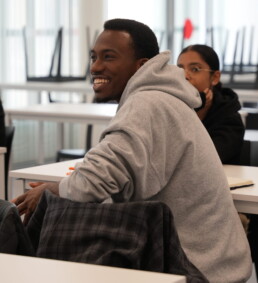
They can take many forms:
- Social and cultural: Expectations about what you “should” study according to your gender or your origin. Or the lack of references in certain professions that make you think: “that’s not for people like me”.
- Economic: It’s not just not being able to pay tuition. It’s not having money for transportation, for books, or having to drop out of school to work and help out at home.
- Attitudinal: Prejudices of teachers or peers who may assume that a student will not be able to go far. It is the famous “Pygmalion effect” in negative: if they expect little from you, you may end up underperforming.
- Institutional: Class schedules that are not compatible with a job, complicated and unaccompanied bureaucratic procedures or lack of support for students with specific needs.
The real impact of what is not seen
Imagine a young woman with a passion for technology who never considers studying engineering because in her environment “that’s a boy thing”. Or a student who can’t afford to go to college because he lives in a rural area with poor communications and the cost of transportation is too high.
These barriers are not abstract; they have very concrete consequences in the lives of young people. They limit their dreams, condition their choices and, in the worst cases, force them to drop out of school.
How can we get rid of these barriers?
Breaking down these barriers requires a collective effort and an attentive eye:
Making education systems more flexible and adaptable
Life is not a straight path, and neither should education be. We need more flexible systems that adapt to the realities of each person. This can mean:
- Offer scholarships that cover not only tuition, but also transportation, materials and lodging.
- Design schedules that are compatible with work life.
- Simplify administrative procedures and offer assistance in carrying them out.
Training and sensitizing educational personnel
Teachers are a central part of the system. Giving them access to personalized academic guidance training allows them to apply this approach throughout the entire educational stage, helping their students to connect their interests and motivations with their future career.
An aware teacher, with the tools to detect prejudices (often unconscious), can identify these barriers and become a real agent of change in the classroom.
Encourage diversity of references
It is essential for young people to see that any path is possible, no matter who they are. Making professionals from diverse backgrounds visible in all fields inspires and breaks stereotypes. It is about broadening our vision and showing that talent has no labels.
Create support and mentoring networks
Sometimes what a young person needs most is someone who believes in them. Reference figures can be a crucial factor in their lives. So it is key to generate spaces where these bonds can be born and grow.
A path that we build together
Overcoming invisible barriers is a challenge that involves institutions, companies and social entities as well as citizens. It is a matter of listening more, judging less and asking ourselves what we can do to make the path of others a little easier.