
CONFLICT AS AN OPPORTUNITY: 4 WORKSHOPS TO TRANSFORM THE WAY WE LOOK AT IT
Ana Caruezo Carnero, science and social communicator.
Conflict is present in the daily life of any educational community. Far from being understood only as an obstacle, it can become an engine for growth, cohesion and learning when it is approached from a careful and conscious point of view.
With this approach, the KOA conference “The opportunity of conflict: opening up to others and building from a space of encounter” brought together professionals in an experiential space designed to deepen new tools, strategies and ways of relating to each other in tense situations.
Throughout the session, four workshops were offered, designed to provide practical resources, open spaces for reflection and accompany professionals in the construction of safer, more connected and collaborative environments. Below, we share the dynamics and main lessons learned from each one of them.
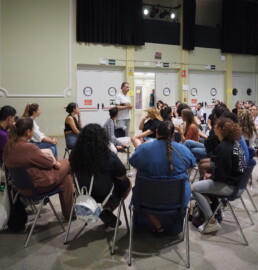
1. Tools for a new perspective (The Elder Way)
This workshop had a clear objective: for participants to take away practical tools to work with conflict as an opportunity for connection and growth. The session began with a dynamic to identify the different roles that arise during a dispute, allowing each person to recognize their own tendency.
Subsequently, they worked with practical cases in small groups. Using a worksheet, the professionals analyzed a conflict, which facilitated guided supervision. The reflections were shared in groups, enriched with feedback from the facilitators, closing with conclusions that helped to consolidate the lessons learned. The key was to move from theory to practice, equipping the professionals with a method applicable to their daily reality.
2. Conflict facilitation workshop (Marina Caireta)
Practical dynamics to represent and reflect on the reality of a conflict and what strategies we use to reach agreements and solve them in an experiential way.
The dynamic consists of:
A volunteer leaves the space and the facilitator gives her the premise that she must sit in a chair and that she cannot get up, no matter what. There are no further instructions. The facilitator returns to the group and before the volunteer enters, she tells the group that her goal is for everyone in the group to sit in the chair at some point. There are no further directions. The idea is that, with different objectives, all parties achieve their goal.
The facilitator should be writing down on a piece of paper what strategies they use (conciliatory, attack, defense, blackmail, etc.) so that the objective of both parties is achieved and so that they can return to the group to encourage reflection. During the dynamics, you should intervene as little as possible. If you are asked questions, you should not facilitate a quick conciliation, because the longer you stay, the more strategies and resources can come to light to work on later. The dynamic can take as long as you consider, but once you have managed to get the volunteer to let someone from the group sit down, it could be finished, depending on the time you have. This part can take approximately 20-30 minutes.
Afterwards, the dynamics can be closed by making different reflections, such as power in relationships (which can vary, and can have a great influence on whether or not the objective is achieved), the conflict matrix can be raised, which depends on the quality of relationships (it depends on trust and cooperation), communication, etc.
3. Non Violent Communication (NVC) with the giraffe and the jackal (Carme Pujol and Julia Peris).
In this Nonviolent Communication workshop, the metaphors of the giraffe and the jackal, created by Marshall Rosenberg, were used. The jackal represents critical and judgmental language, while the giraffe symbolizes empathetic and respectful communication.
Through these two stuffed animals and real examples, the facilitators explained the basic steps to transform our way of communicating. They proposed a practical dynamic in which the participants, in small groups, worked to change a “jackal” language to a “giraffe” one. The objective was to foster respect for oneself and for others, learning to express needs and emotions in a clear and constructive way, without attacking or judging.
4. Restorative practices with projective cards (Òscar Negredo)
This session introduced the use of projective cards as a tool to facilitate spaces for introspection and to accompany the identification of emotional states in adolescents. These cards can be used in different moments of a session so that each person can connect with their emotions and express them.
The dynamic consisted of spreading the cards on the floor and posing an open-ended question, such as “What do you expect from this course?” or “What do you need in order to feel comfortable in this space?” Participants walked around, looked at the images, and chose the one that best represented their answer. Finally, in a round robin, each shared why they made their choice.
Òscar shared some tips to energize the activity:
- Create an environment of trust and security.
- Formulate open-ended questions that invite reflection.
- Remember that there are no right answers, only personal perspectives.
- Validate all contributions to strengthen participation.
This workshop offered a very visual and creative resource to foster spaces of expression where all people involved in a conflict have a voice.
Towards constructive conflict management
These four workshops demonstrated that a constructive approach to conflict is possible. With the right tools, professionals can transform moments of tension into opportunities to strengthen bonds, foster self-knowledge and accompany adolescents in their emotional and social development.
If you are interested in this type of resources to energize your sessions with teenagers, in the free digital space of KOA you will find many more!